Jeff Sifers, Assistant District Attorney for Grady County, discusses his work in the district's Drug Court.
The December 22, 2022 meeting of the Rotary Club of Chickasha was called to order by President Lewis Knisley. Rotarian Mitch Williams led the club in singing "Down at the Leg Lamp", a parody of "Down on the Boardwalk".
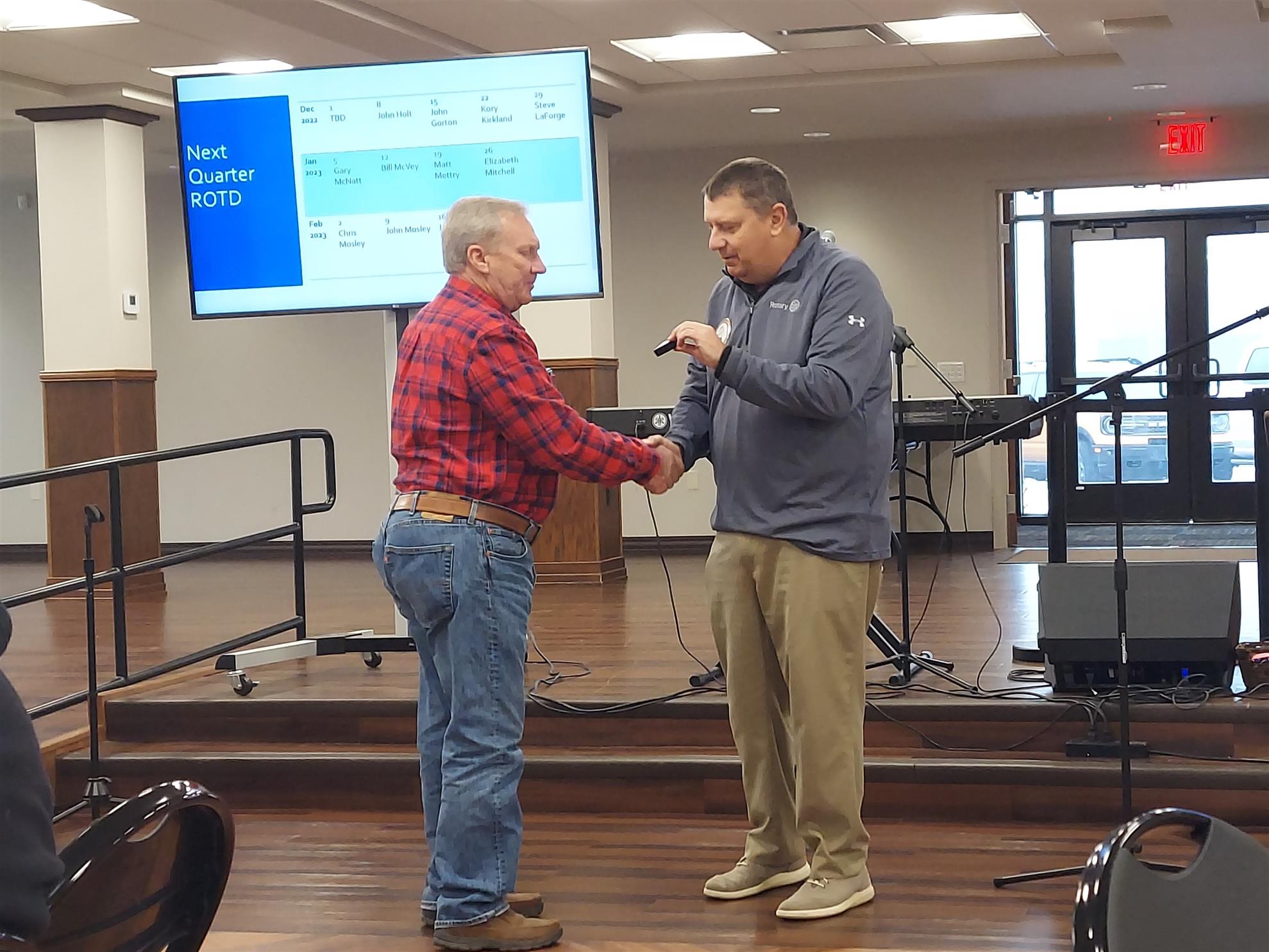
Rot. Tim Elliott, left, receives the Paul Harris Award from Pres. Knisley.
Two presentations were made. First, Rot. Tim Elliott received his second Paul Harris Award. The Paul Harris Award is given for every $1,000 donated to The Rotary Foundation. Second, a $500 donation was presented to the Chickasha Public School Foundation. This donation was made towards mentorship programs at CPS, particularly Gentlemen of Distinction and Diamonds in the Rough.
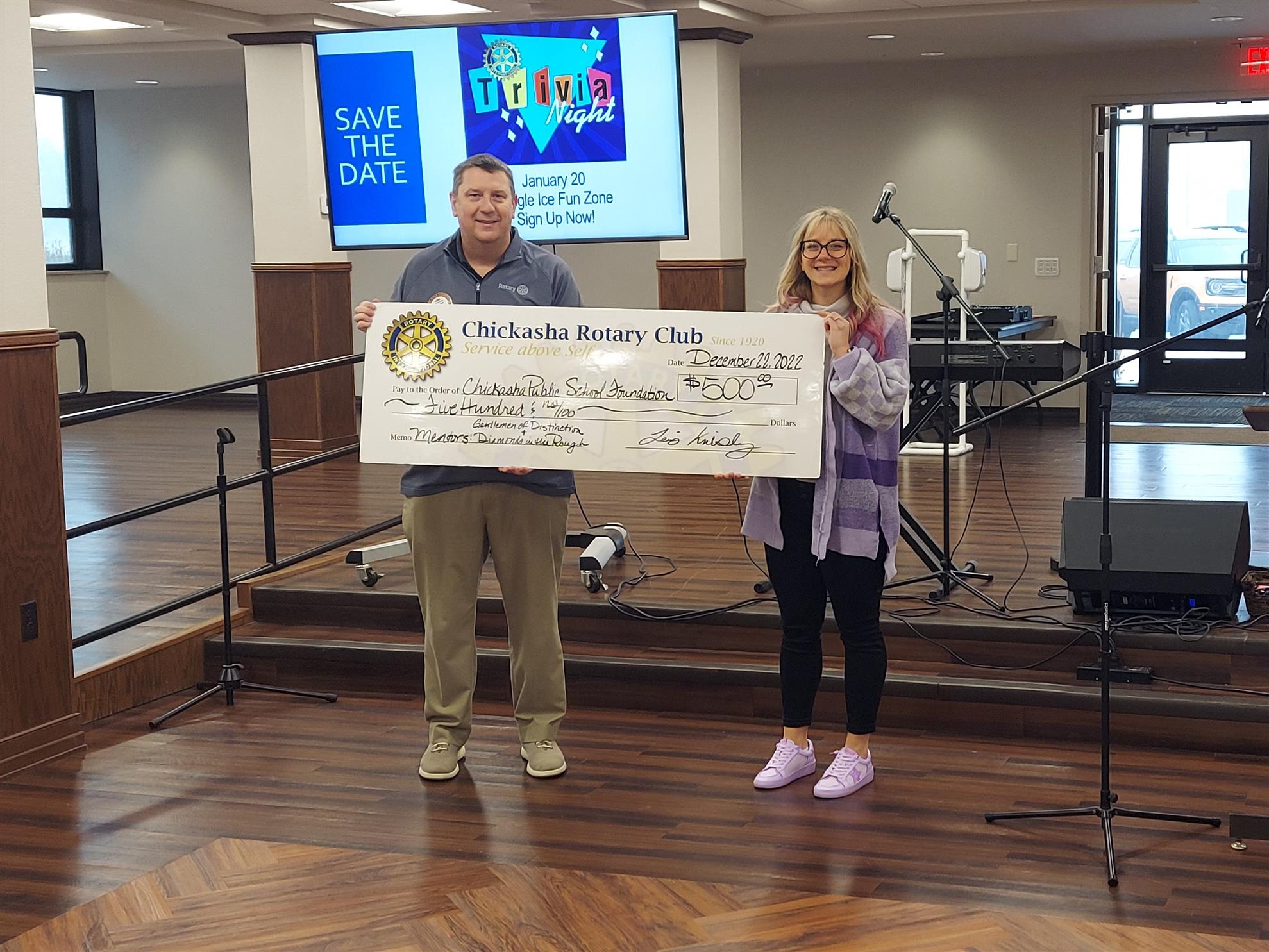
Pres. Knisley presents a donation to the CPS Foundation for its mentorship programs.
Pres. Knisley then delivered announcements:
- The Rotary Roll Call assemblies for the second nine weeks will be held January 5th at 2:00 pm (Grand Elementary) and January 12th at 1:15 pm (Lincoln Elementary).
- January's Trivia Night will be held Friday, the 20th, at 7pm. It will be at Jungle Ice Fun Zone. The theme will be "2022 Year in Review".
Rotarian of the Day Kory Kirkland introduced his speaker, Assistant District Attorney Jeff Sifers. Kirkland explained that the drug court was a personal priority for him, and that "drug court only works if you have a prosecutor who cares." He said that Sifers fits the bill.
Sifers, who works under District Attorney Jason Hicks, oversees the Grady County office of the district drug court. Drug court, Sifers explaned, is an adult treatment program, that requires the cooperation of "the prosecutor, defense, health providers, and presiding judge." Sifers saw from an early time in both his career and his life the impact that substance abuse and addiction can have on the family. As an ADA, he specifically requested to be assigned to drug court. He said that a principle of the program is that "by giving back, you move yourself forward."
In order to apply for drug court, a person must be charged with a non-violent felony. It must be a "drug-driven crime that [the person] is willing to take responsibility for." There are around 13 people currently in the program in Grady County.
Sifers acknowledged that recent state initiatives that relaxed punishments on drug-related offenses have presented unique challenges to drug court. Sifers and his team have to identify worthy candidates for the program among those arrested for possession with intent to distribute. He said that "taking a chance" on seemingly less qualified applicants has paid off in some cases, but hasn't in others. He added that most people in the program are incarcerated and unable to make bail, so drug court is their path out of jail.
To enter the program, applicants must complete a background check, assessment, and a pre-phase. If they complete the pre-phase with no sanctions, they can plead into the program. The program itself consists of four phases of treatment and one phase of aftercare. A person who graduates drug court can have their case dismissed, or their sentence deferred or suspended. Sifers said that they have seen many great success stories come out of the drug court program.
Catering provided by Rock Island Grill.