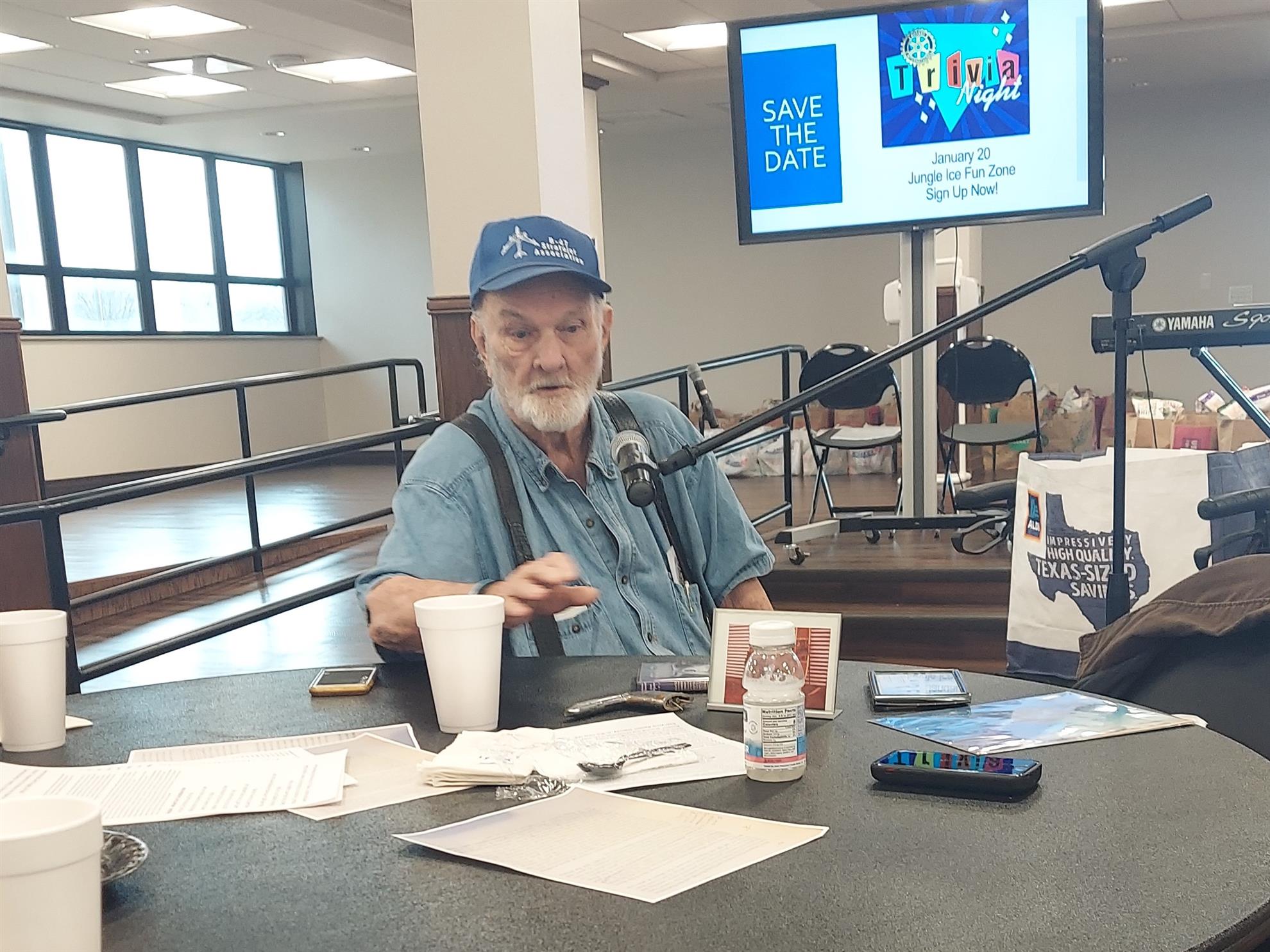
Chickasha native and U.S. Air Force veteran Homer Hulme told stories about his service in the Cold War.
The December 29, 2022 meeting of the Rotary Club of Chickasha was called to order by President Lewis Knisley. Rot. Mitch Williams led the club in singing "Rockin' Around the Christmas Tree".
Pres. Knisley delivered announcements:
- Trivia Night will be Friday, January 20, at 7pm. It will be at Jungle Ice Fun Zone.
- The Rotary Roll Call assembly at Grand Elementary will be next Thursday, January 5, at 2:00 pm. The assembly at Lincoln Elementary will be Thursday, the 12th, at 1:15 pm.
Rotarian of the Day Steve LaForge introduced his speaker, Homer Hulme. Hulme was born in Chickasha and lived in it all his life, outside of college and military deployment. He is a CPA and was a teacher at Science & Arts. Hulme is also an U.S. Air Force veteran who served in the Strategic Air Command during the Cold War.
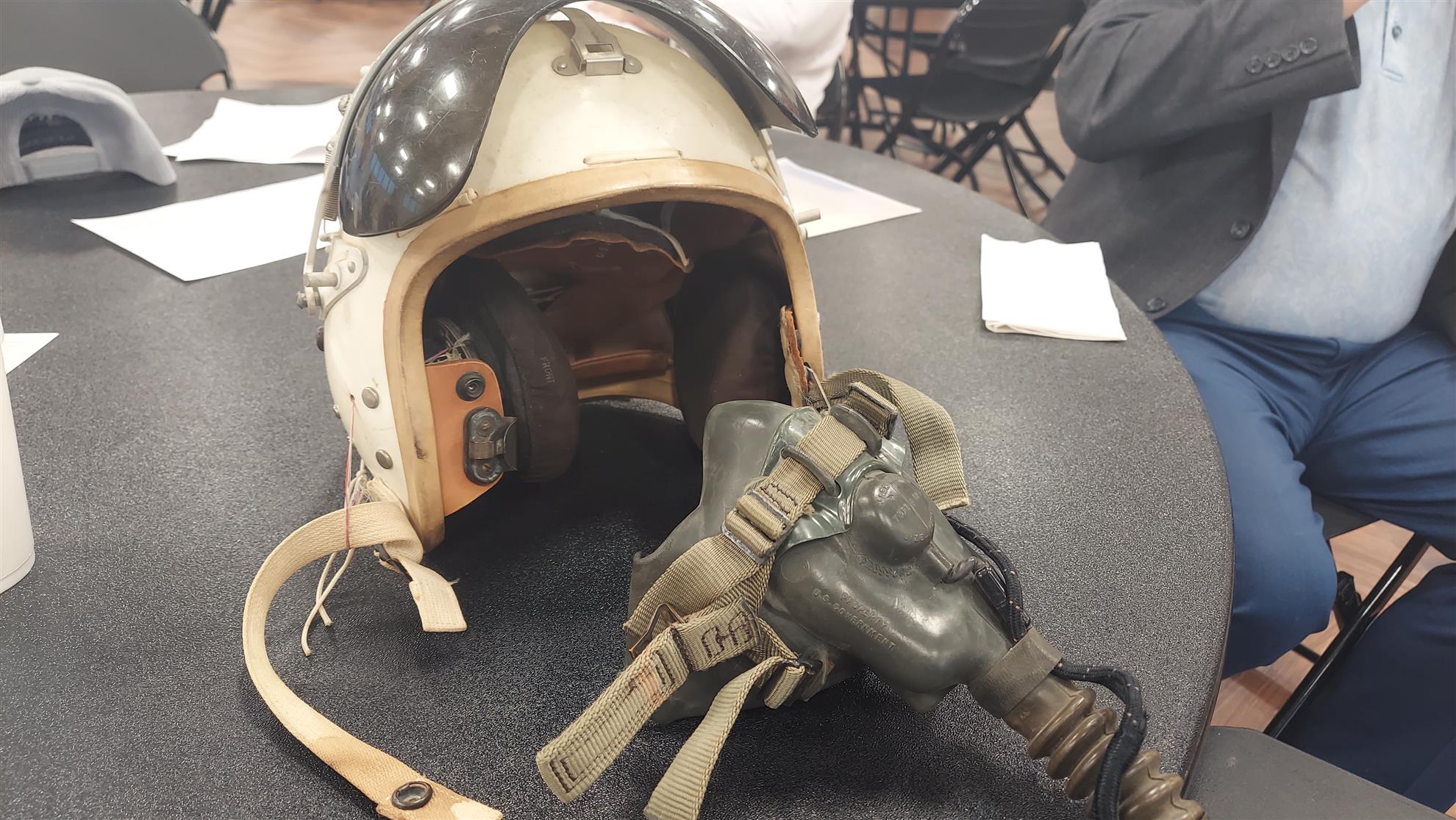 Hulme's flight helmet, which was custom made. | 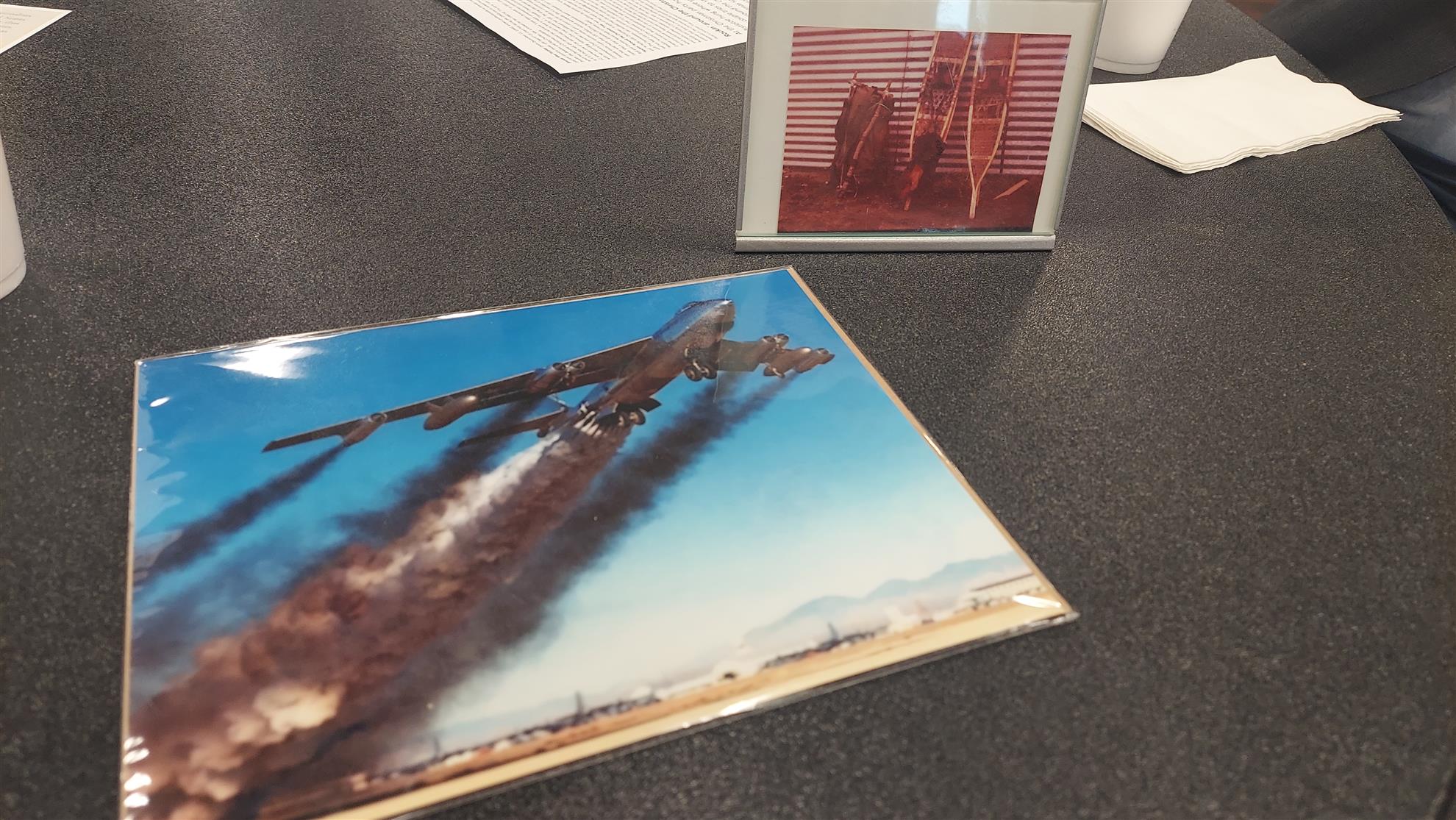 Photos from Hulme's military career, including the plane model he flew, the B-47 (front).. |
Hulme was a part of ROTC at the University of Oklahoma, where he was offered a commission immediately upon graduation, which he turned down. Hulme joked that while "they couldn't imagine someone turning it down, I couldn't imagine being told what to do for the rest of your life." While training in the USAF, he was one of 5 trainees who opted to learn multi-engine planes rather than single-engine. This allowed him to obtain a commercial pilot's license. Hulme was trained to fly the B-47, a massive bomber plane with 6 engines.
Hulme's crew was stationed in Salina, Kansas in 1958. They became involved in the response to the Lebanon crisis of that year, which had both U.S. and Soviet involvement. Hulme's crew was sent to Greenham Common, England, where they kept their planes ready in case the worst happened. If tensions had escalated to all-out war, Strategic Air Command was on standby in various bases worldwide in order to deploy nuclear bombs.
According to Hulme, if they were to be deployed, they would receive a certain signal, where they would open sealed instructions. If the instructions said to launch, they were to immediately cut radio communication, and fly to Moscow with the nuclear weapons. They could not be recalled. Since radio was cut, the crew's navigator would guide them "celestially" with a sextant, the same way sailors had done for centuries. Even without having launched, Hulme said the tension was so great that "nothing has scared me since."
Hulme also shared two things he learned from his Cold War service. First, recalling how they were to land in Sweden if they managed to get through Moscow, he said "neutrality doesn't mean a damn thing" in war. Second, while the United States claims it would never issue a pre-emptive strike, Hulme knew differently—there were "nineteen war options, and one of them was a pre-emptive strike."
Hulme has been part of the Chickasha Municipal Airport committee since 1961. In response to a question about the airport, he said it is a "great facility". He added that it has good service and good refueling capacity for an airport of its size. The runway size is something of a limiting factor, but it is sufficient for most purposes.
Lunch was provided by Cotton Patch Cafe.