 Members of Youth Action for Healthy Leadership (YAHL) from Ninnekah High School spoke to Rotary about the CounterAct Tobacco initiative and the importance of regulating vapes and e-cigarettes for young people.
The Rotary Club of Chickasha met February 22, 2024. Rotarian Mitch Williams led the club in singing "Shoulda Been a Cowboy".
President Jim Cowan announced that the new playground equipment, paid for by the club with a district grant, had been installed at Resurrection House. Members are invited to attend a brief "ribbon cutting" on Monday, February 26, at 2:00 pm.
As Rotarian of the Day, Heather Roehrick introduced the program. The speakers were part of TSET's Youth Action for Healthy Leadership (YAHL) program—coordinator Aisha Ensley and Ninnekah High School students JJ Jerdee, Jacob Horn, and Eli Brake.
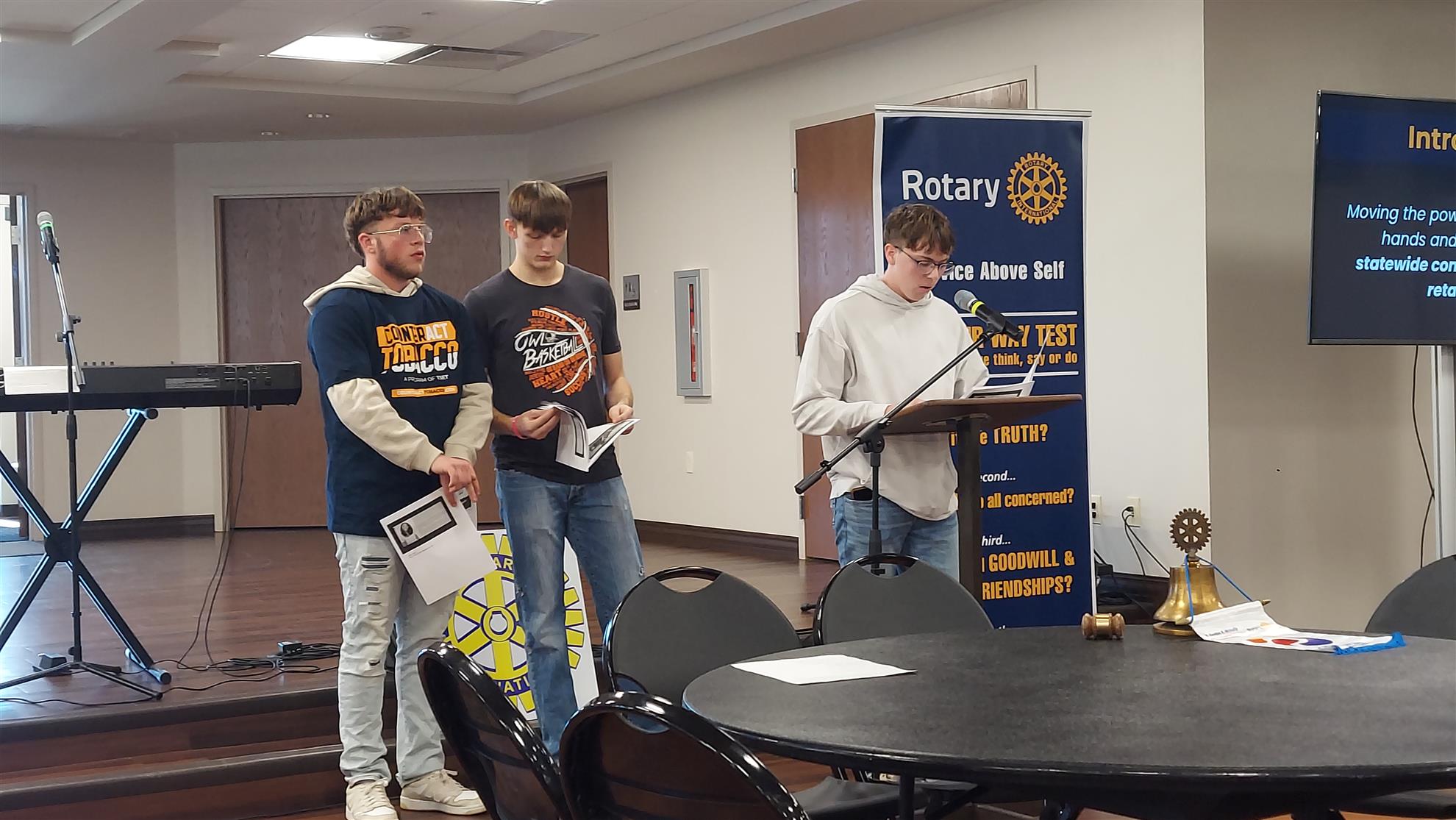
YAHL is a youth-led health initiative supported by TSET, involved in high schools around the state. One of the campaigns run by YAHL participants is CounterAct Tobacco. The goal of CounterAct Tobacco is to decrease tobacco usage in youth by regulating the sale of vapes and e-cigarettes.
The campaign, which seeks to "hold Big Tobacco accountable", operates by educating and mobilizing students, increasing public awareness, advocating for the regulation of non-cigarette tobacco products, and building relationships with lawmakers. Meeting attendees participated in a survey concerning tobacco and vape use.
According to surveys, 21.7% of high school students in Oklahoma reported using vapes. The speakers explained that vape products on the market are made appealing to young people through flavors, design, and packaging. Some products are even designed to pass for school supplies to avoid detection in classrooms.
They further explained that unlike with cigarettes, retailers do not require a particular license to sell vapes and e-cigarettes. As a result, regulators may not be aware that a store is selling vapes, and therefore cannot inspect and verify that it is not selling these tobacco products to minors. The lack of regulation is compounded by Oklahoma having preemption laws for smoke-free air, licensing, and youth access to tobacco—one of only five states to have such laws. Preemption dictates that municipalities cannot pass their own regulations in the aforementioned areas, unless those ordinances exactly align with state law. In other words, it is impossible for cities to create or enforce stricter controls on tobacco use if desired; these matters can only be regulated at the state level.
The students clarified that they do not seek to restrict personal freedoms and bodily autonomy. Rather, they are advocating for accountability and local control in the decision-making process.
Lunch was provided by Chicken Express.